Global Acoustic Insulation Market By Overview
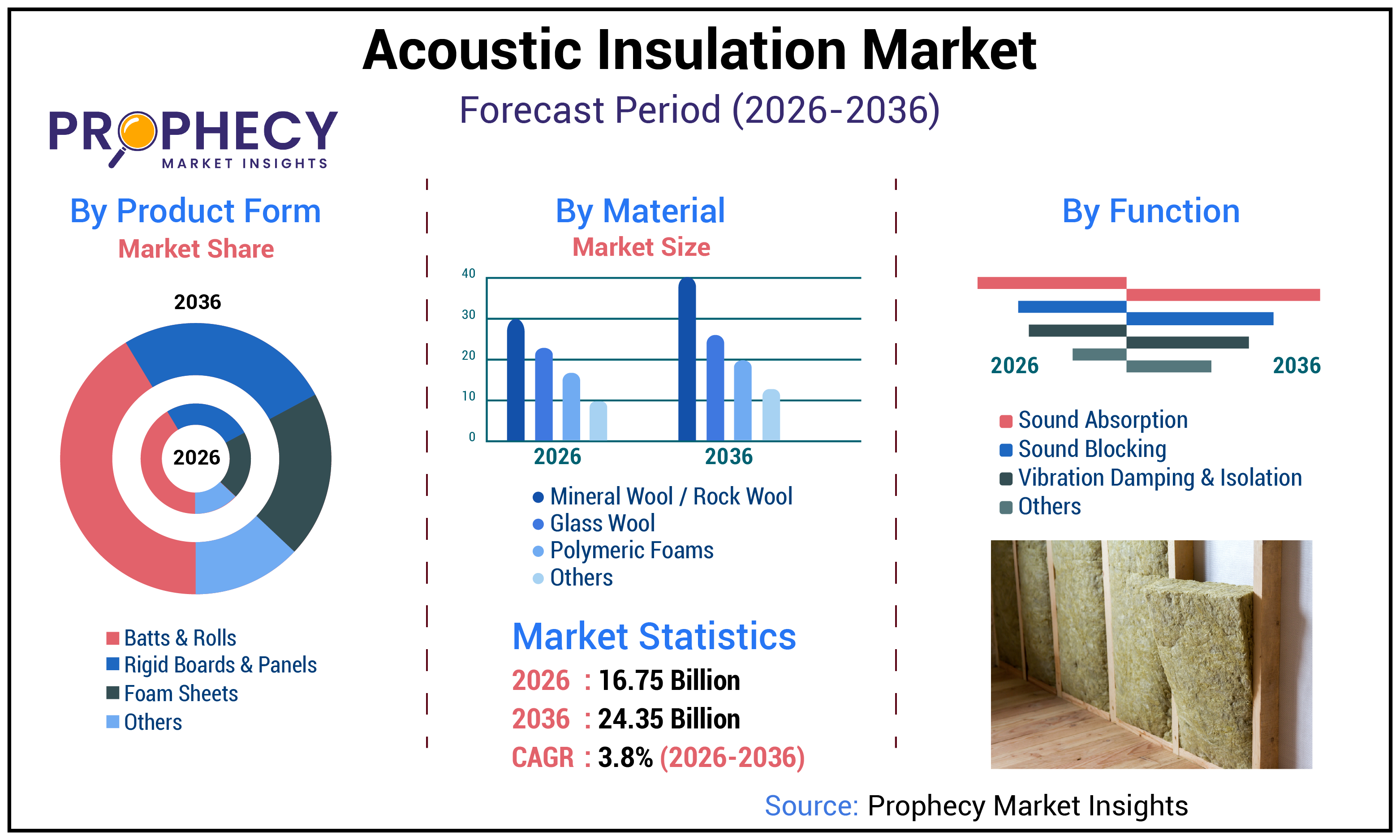
- 2025 Market Size: USD 16.75 Billion
- 2036 Projected Market Size: USD 24.35 Billion
- CAGR (2026-2036): 3.8%
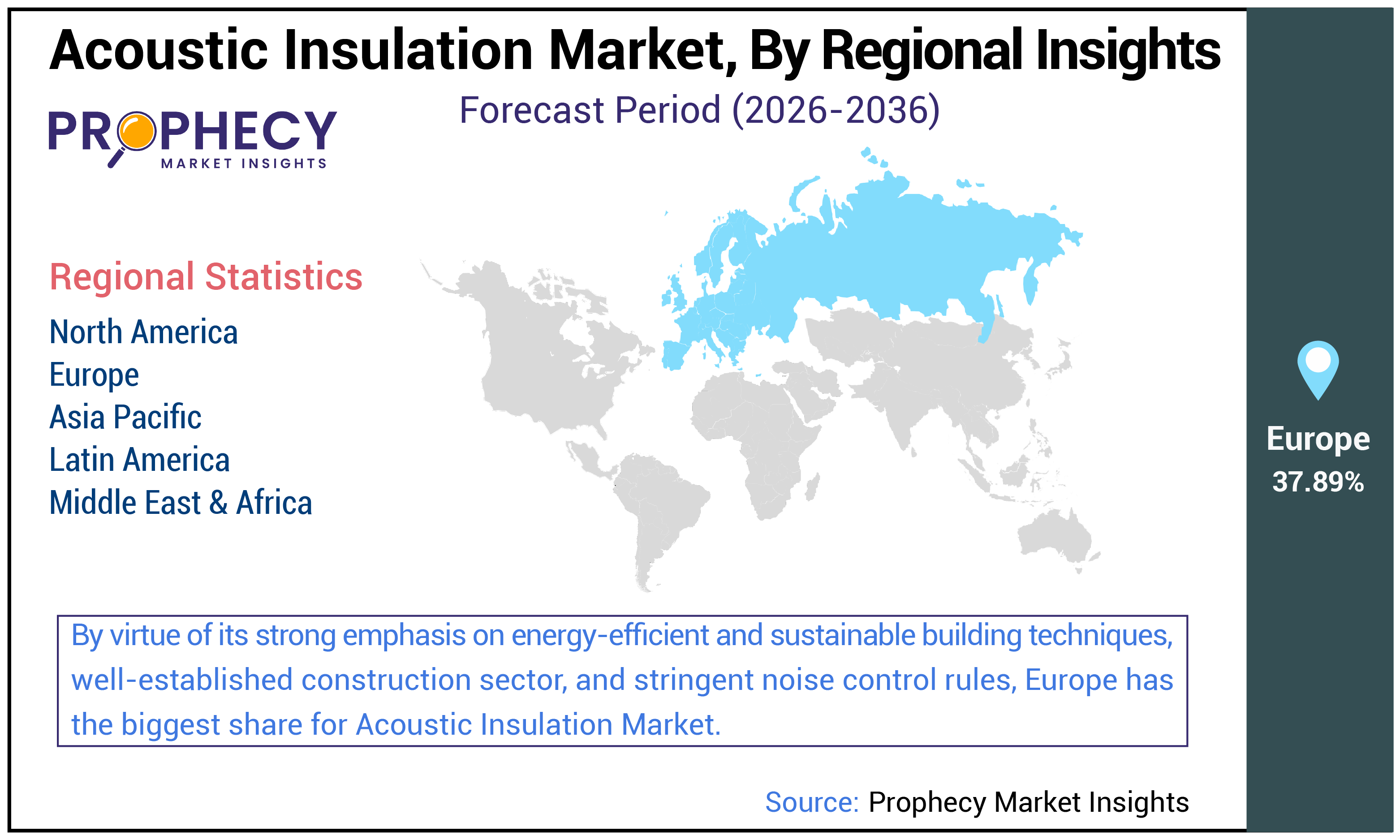
- Europe: Largest Market in 2025
Acoustic insulation are the materials and systems that are specifically designed to limit the transmission of sound from one area to another by absorbing, blocking, or dampening noise. Acoustic insulation is a source of comfort, privacy, and productivity that is spread over homes, automobiles, and factories. The main advantages of acoustic insulation are to lower noise levels, enhance sound quality, increase energy efficiency (since most of the materials also serve as thermal insulation), improve concentration and mood in residential or working environments, and meet building and safety regulations.
The expansion of the acoustic insulation market is a consequence of a number of factors such as booming urbanization, quick infrastructural development, and the imposition of severe noise control regulations in the residential, commercial, and industrial sectors. Adoption is being propelled by the rising awareness of the negative effects of noise pollution on health as well as the demand for comfortable and energy-efficient buildings.
Besides that, the automotive, railway, and aerospace industries, among others, are using the acoustic materials to attract the customers with the comfort of the journey. The worldwide development of the market is being propelled by the trend of using insulated materials that are environmentally friendly and resource-efficient.
Regulatory Scenarios for Acoustic Insulation:
- The sound insulation regulations have been profoundly influenced by the building codes and air quality standards that have been put in place to limit noise pollution and to provide comfortable living conditions to the residents.
- The local authorities and international organizations such as the World Health Organization (WHO), the European Union (EU), and federal agencies as the U.S. Environmental Protection Agency (EPA), and the Building Research Establishment (BRE) have established the norms and standards regarding noise levels and sound transmission in buildings.
- Noise regulations as EU Building Acoustics Standards (EN 12354) and ISO 140 series define the devices used for sound insulation measurement along with the performance criteria.
- These regulations encourage the use of certified materials that are environmentally friendly and meet safety from fire, energy-saving, and other ecological requirements, thus, turning into a source of innovation and quality in the acoustic insulation market.
Current Industry Dynamics & Insights:
- Europe has the largest regional share in the market, with almost 37.89%.
- Asia Pacific is second dominating region in the market.
- By product form, batts & rolls dominate the acoustic insulation market growth.
Global Acoustic Insulation Market By Drivers & Restraints
|
Drivers |
Restraints |
Opportunities & Trends |
|
|
|
Key Drivers:
Rising Urbanization
One of the major factors that have led to the expansion of the acoustic insulation market is the rapid urbanization which is the primary cause of the demand for different types of construction. These buildings are developed in residential, commercial, and industrial areas which are very close-packed, thus noise control is necessary for the people's comfort and health.
As cities grow, the population density and traffic noise have increased significantly compared to before, resulting in stricter building codes and a higher demand for soundproof places. Acoustic insulation is being used more and more in urban infrastructure projects such as offices, schools, hospitals, and transport systems to improve the quality of life and increase staff productivity, which, in turn, is encouraging the market to continue expanding.
- For instance, according to the data published by World Bank Group, currently, 4.4 billion people, or more than half of the world's population, reside in urban areas. This trend is predicted to continue, with nearly seven out of ten people living in cities by 2050, when the urban population is predicted to more than quadruple.
Restraints:
Challenges in Balancing Acoustic Performance with Fire Safety and Thermal Efficiency
The difficulty of combining fire safety and thermal efficiency with good acoustic performance has been a major reason for the limited growth of the acoustic insulation market where not all materials that provide good sound insulation also comply with the requirements of fire resistance and energy standards.
For example, polymer-based acoustic materials can be very efficient in sound absorption and at the same time can be a source of fire hazard and have low thermal insulation. Consequently, designers and manufacturers encounter problems in building and complying with regulations.
- Counterbalance Statements: The answer is in the creation of multi-functional, high-performance materials like mineral wool, glass wool, or advanced composites that have the symbiotic properties of soundproofing, fire resistance, and thermal efficiency, with the help of ongoing R&D and compliance with international safety certifications.
Opportunities & Trends:
Adoption of Nanotechnology and Advanced Polymers
In large part, the acoustic insulation market will be profoundly influenced by the integration of nanotechnology and advanced polymers that is gradually becoming the main-future trend. In fact, these technologies promote the creation of materials that are not only lightweight, durable, and highly efficient in sound absorption but also attractive from the ecological standpoint.
Nanomaterial improve the molecular structure of the insulation to achieve better sound absorption, fire resistance, and thermal performance all at the same time. Polymers of the future as nano-foams and smart composites provide for the acoustic customizable properties as well as the ease of installation in small or complicated structures.
Global Acoustic Insulation Market By Segmentations & Regional Insights
Product form, material, function, end user, and region are the divisions of the acoustic insulation market.
By Product Form:
Batts & rolls, rigid boards & panels, foam sheets, and others are product form on which acoustic insulation market is segmented. Considering they are inexpensive, simple to install, and frequently used for walls, ceilings, and floors in both residential and commercial construction, batts and rolls have the most acoustic insulation market share.
The second-dominant category is rigid boards and panels, which are perfect for workplaces, auditoriums, and industrial facilities where both performance and appearance are crucial due to their exceptional durability, strong sound absorption, and aesthetic appeal.
By Material:
Based on the material, the acoustic insulation market is divided into mineral wool / rock wool, glass wool, polymeric foams, and others. In addition to its superior sound absorption, high fire resistance, thermal efficiency, and durability, mineral wool, also known as rock wool, has the biggest acoustic insulation market share and is a material of choice for commercial, industrial, and residential structures.
The second most popular material category is glass wool, which is prized for its affordability, adaptability, and lightweight design. It is perfect for large-scale construction projects where cost and ease of installation are important considerations because it offers good thermal and acoustic insulation.
By Function:
The acoustic insulation market is categorized into sound absorption, sound blocking, vibration damping & isolation, and others on the account of function. In light of its widespread application in residential, commercial, and institutional buildings to reduce reverberation, improve speech clarity, and increase overall interior comfort, sound absorption has the biggest acoustic insulation market size.
The second most important purpose is sound blocking, which is motivated by the increasing requirement to stop noise from moving across rooms and floors, particularly in urban and multi-family housing developments where privacy and legal compliance are important issues.
By End User:
The acoustic insulation market on the account of end user is categorized residential construction, industrial & manufacturing, transportation, and others. The combination of the fast expansion of urban housing, growing awareness of noise pollution, and tighter building regulations requiring soundproofing for privacy and comfort, residential construction has the greatest acoustic insulation market share.
Considering factories and production facilities need acoustic insulation to minimize machinery noise, maintain worker safety, and comply with occupational noise standards, this sector consistently adopts it, making industrial and manufacturing the second-dominant end-user segment.
Regional Insights:
Geographically, the acoustic insulation market is studied across North America, Europe, Asia Pacific, Latin America, and the Middle East & Africa.
Europe: By virtue of its strong emphasis on energy-efficient and sustainable building techniques, well-established construction sector, and stringent noise control rules, Europe has the biggest share for acoustic insulation market.
- Germany Acoustic Insulation Market Insights:
Between its robust constructions industry, sophisticated manufacturing base, and stringent building standards that prioritize energy efficiency and noise control, Germany leads the European acoustic insulation market.
Asia Pacific: The second-dominant region is Asia-Pacific, which is driven by growing investments in smart cities and infrastructure development, as well as fast urbanization, industrialization, and construction activity in nations including China, India, and Japan. These factors increase the demand for efficient noise insulation solutions.
- China Acoustic Insulation Market Insights:
The country's widespread urbanization, quick infrastructure development, and rising demand for residential and commercial space, China dominates the Asia-Pacific (APAC) market. The increasing use of acoustic insulation materials in China is also a result of government programs that support environmentally friendly and energy-efficient construction.
North America: Stricter building regulations, increased awareness of indoor comfort, and an increase in renovation projects in both the residential and commercial sectors are driving growth in the North American acoustic insulation market.
- U.S. Acoustic Insulation Market Insights:
The U.S. leads the North American market owing to extensive urbanization, high infrastructure spending, and rising demand for soundproofing in workplaces, medical facilities, and educational institutions. The U.S. market position is further strengthened by developments in green construction efforts and sustainable insulation technology.
Acoustic Insulation Market Report Scope:
|
Attribute |
Details |
|
Market Size 2026 |
USD 16.75 Billion |
|
Projected Market Size 2036 |
USD 24.35 Billion |
|
CAGR Growth Rate |
3.8% (2026-2036) |
|
Base year for estimation |
2025 |
|
Forecast period |
2026 – 2036 |
|
Market representation |
Revenue in USD Billion & CAGR from 2026 to 2036 |
|
Regional scope |
North America - U.S. and Canada Europe – Germany, U.K., France, Russia, Italy, Spain, Netherlands, and Rest of Europe Asia Pacific – China, India, Japan, Australia, Indonesia, Malaysia, South Korea, and Rest of Asia-Pacific Latin America - Brazil, Mexico, Argentina, and Rest of Latin America Middle East & Africa – GCC, Israel, South Africa, and Rest of Middle East & Africa |
|
Company Landscape |
Market Share Analysis of Companies Heat Map Analysis Company Overview, Products Overview Financial Information, Key Highlights Business Strategies Overview SWOT Analysis |
|
Report coverage |
Revenue forecast, company share, competitive landscape, growth factors, and trends |
|
Value Added Data Infosets |
Besides fundamental market insights such as the size of the market, growth rate, segmentation, regional study, and key players, our reports carry value-added data sets such as trade flow (import-export) analysis, production and consumption overview, price trend evaluation, supply and value chain mapping, and raw material availability. Moreover, we provide strategic tools as PESTLE and Porter’s Five Forces analysis, examination of the regulatory landscape, as well as monitoring of technology and innovation thereby providing a comprehensive overview which facilitates sensible and anticipatory decision-making. |
Segmentation:
By Product Form:
- Batts & Rolls
- Rigid Boards & Panels
- Foam Sheets
- Others
By Material:
- Mineral Wool / Rock Wool
- Glass Wool
- Polymeric Foams
- Others
By Function:
- Sound Absorption
- Sound Blocking
- Vibration Damping & Isolation
- Others
By End User:
- Residential Construction
- Industrial & Manufacturing
- Transportation
- Others
By Region:
- North America
- U.S.
- Canada
- Europe
- Germany
- U.K.
- France
- Russia
- Italy
- Spain
- Netherlands
- Rest of Europe
- Asia Pacific
- China
- India
- Japan
- Australia
- Indonesia
- Malaysia
- South Korea
- Rest of Asia Pacific
- Latin America
- Brazil
- Mexico
- Argentina
- Rest of Latin America
- Middle East & Africa
- GCC
- Israel
- South Africa
- Rest of Middle East & Africa
Global Acoustic Insulation Market By Competitive Landscape & Key Players
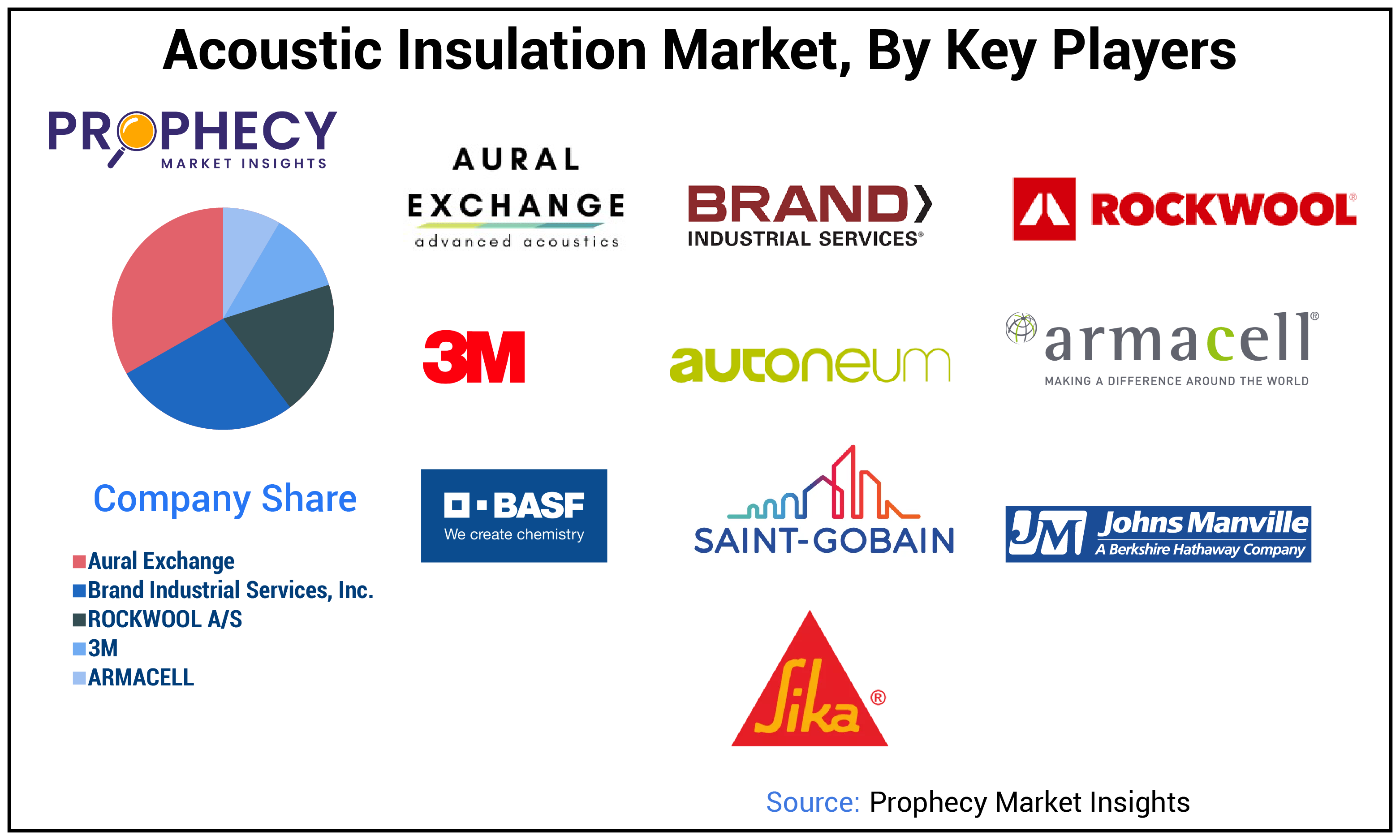
Investing in research and development to provide high-performance, sustainable materials that combine soundproofing with fire safety and thermal efficiency is one of the main growth strategies for acoustic insulation companies. In order to improve their product portfolios and increase their global presence, businesses are also concentrating on strategic alliances, mergers, and acquisitions. Product integration and installation efficiency are enhanced by the use of digital design tools as BIM and acoustic modeling.
Acoustic Insulation Market Companies:
- Aural Exchange
- Brand Industrial Services, Inc.
- ROCKWOOL A/S
- 3M
- ARMACELL
- Autoneum
- Saint-Gobain Group
- Owens Corning
- BASF
- Kingspan Group
- Fletcher Insulation
- Johns Manville
- Sika AG
- Autoneum
- Huntsman
View an Additional List of Companies in the Acoustic Insulation Market
Global Acoustic Insulation Market By Recent News
- In September 2025, with the introduction of M.A.D. and Impactodan, two cutting-edge acoustic insulation solutions, TIKIDAN, a well-known brand in the construction chemicals and building materials sector for more than 60 years, has broadened its product line. These high-performance systems, which may be installed on floors, walls, and ceilings, are made to absorb impact noise and low-frequency airborne sounds.
- In June 2025, a novel acoustic partition wall component was introduced by Ruukki Construction, a division of SSAB and a top provider of environmentally friendly steel-based construction solutions. The Ruukki Sono acoustic partition wall element promotes acoustic comfort to even the most demanding indoor conditions and offers best-in-class sound absorption. It is designed for industrial and office construction.
Analyst View:
The acoustic insulation market is expanding as a result of growing urbanization, infrastructure development, and more stringent noise control laws in the commercial, industrial, and residential sectors. In addition to increasing comfort, privacy, and productivity, acoustic insulation materials improve energy efficiency by absorbing, blocking, or dampening sound.
Adoption is being driven by growing awareness of the negative health impacts of noise pollution and the need for sustainable, energy-efficient buildings. The market's worldwide expansion is further aided by growing applications in the rail, automobile, and aerospace sectors to improve passenger comfort.
Analysis of Sources:
Primary Sources:
- In-depth interviews
- Company-specific data
- Surveys and questionnaires
- Focus group discussions (FGDs)
- Others
Secondary Sources:
- World Bank
- International Organization for Standardization (ISO)
- European Commission (EC)
- Others
More Related Reports
Electrical Insulation Paper Market
Commercial Insulation Market
Acoustic and Thermal Insulation for Electric Vehicles Market
Surface Acoustic Wave Sensor Market
Automotive Acoustic Engineering Services Market
Global Acoustic Insulation Market By Company Profile
|
Company Name |
Product Portfolio |
|
Knauf Insulation |
Acoustic Insulation Products and Solutions |
|
Brand Industrial Services, Inc. |
Acoustic Insulation |
|
ROCKWOOL A/S |
Acoustic Insulation |
|
Owens Corning |
Acoustic Ceiling Insulation Products |
|
ARMACELL |
Acoustic Solutions |
Global Acoustic Insulation Market By Highlights
FAQs
Acoustic insulation market size was valued at USD 16.7 Billion in 2026 and is expected to reach USD 24.35 Billion by 2036 growing at a CAGR of 3.8%.
Product form, material, function, end user, and region are the segmentation for the acoustic insulation market.
Urbanization and infrastructure development, increasing awareness of noise pollution and its health impacts, strict government regulations and building codes, demand from the automotive and construction industries, and so on are some of the acoustic insulation market growth drivers.
North America, Asia Pacific, Europe, Latin America, and the Middle East & Africa. Europe is expected to dominate the acoustic insulation market.
The key players operating the acoustic insulation market include Aural Exchange, Brand Industrial Services, Inc., ROCKWOOL A/S, 3M, ARMACELL, Autoneum, Saint-Gobain Group, Owens Corning, Kingspan Group, Fletcher Insulation, Johns Manville, Sika AG, Autoneum, and Huntsman.