Global DNA Sequencing Market By Overview
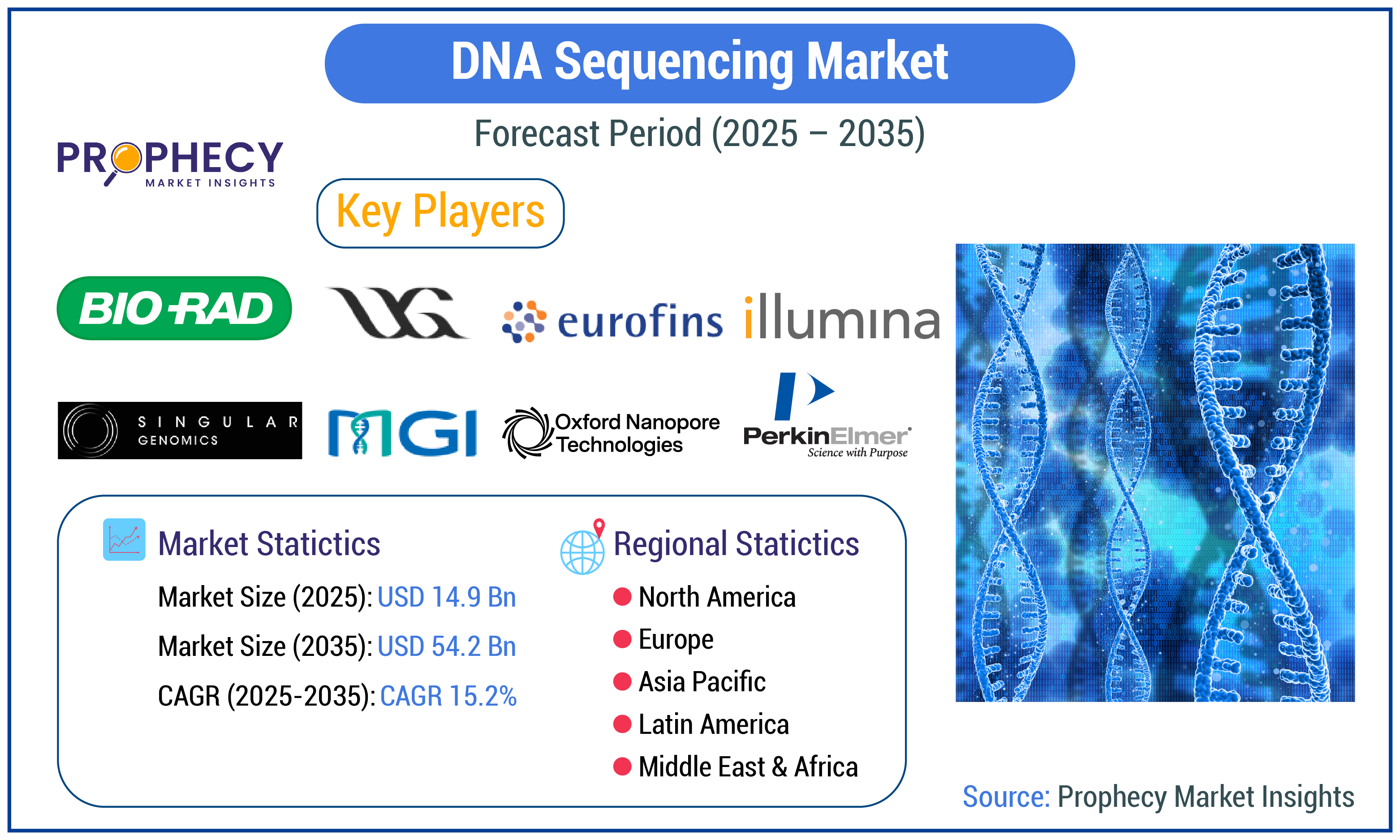
- By 2035, the market is expected to reach USD 54.2 Billion.
- DNA sequencing market size was valued at USD 13.1 Billion in 2024.
- Target market is developing at a CAGR of 15.2%.
DNA sequencing is the process of determining the nucleic acid sequence in the order of nucleotides in DNA. It includes any method or technology that is used to determine the order of the four bases, adenine, guanine, cytosine, and thymine. The advent of rapid DNA sequencing methods has greatly accelerated biological and medical research and discovery.
There are several advantages of DNA sequencing such as identifying genetic variations, identifying crime suspects, detecting pollutant organisms, studying endangered species, improving agriculture, analyzing taxonomic differences, high throughput sequencing, high resolution, and delivering quantitative measurements. These factors contribute to DNA sequencing market growth. Additionally, the increasing demand for personalized medicine, the need for faster cancer diagnosis, and the development of new technologies, also fuels the DNA sequencing market growth.
Impact of AI on DNA Sequencing Market:
Artificial intelligence( AI) significantly impacts DNA sequencing by enabling briskly, more accurate analysis of large volumes of inheritable data, allowing experimenters to identify complaint- associated mutations, prognosticate treatment responses, and epitomize drug grounded on individual inheritable biographies, all while reducing the time and cost involved in the process.
Global DNA Sequencing Market By Drivers & Restraints
Key Drivers of Target Market:
The capability of DNA Sequencing to Identify Genetic Variations is Boosting the market growth.
DNA sequencing is a laboratory approach used to determine the exact order of nucleotides in a DNA beachfront, allowing scientists to identify inheritable variations by comparing the sequence of an existent's DNA to a reference genome, revealing differences, such as single nucleotide polymorphisms( SNPs), insertions, elisions, or dupe number variations, which can be linked to specific traits or conditions. Basically, by reading the law of DNA, experimenters can pinpoint where inheritable variations live within an existent's genome.
- For instance, in April 2023, researchers at the broad Institute of MIT and Harvard developed a new approach to next-generation sequencing that detected genetic mutations or genetic variations within single molecules of DNA. This method was called the Concatenating Original Duplex for Error Correction (CODEC), which makes next-generation sequencing about 1000 times more accurate and opens up the possibility of a range of applications including detecting tiny numbers of cancer mutations in blood samples, monitoring cancer during and after treatment, and identifying mutations underlying rare diseases, all at relatively low cost.
Restraints:
Ethical Concerns of DNA Sequencing is Obstructing the Market Growth
Ethical concerns girding DNA sequencing primarily revolve around the eventuality for inheritable information to be misused, leading to discrimination in areas, such as employment, insurance, and healthcare, alongside privacy concerns regarding the sensitive nature of particular inheritable data, and issues related to informed concurrence and the interpretation of complex inheritable results, especially when dealing with implicit unborn health pitfalls. This leads in obstructing the market expansion.
- Counterbalance Statements: Robust data protection measures, clear guidelines on informed consent, and legislation prohibiting genetic discrimination in areas, such as employment and insurance are the possible solutions for this issue.
Opportunities:
Advances in Bioinformatics can Boom the DNA sequencing market expansion.
Combining DNA sequencing technologies with sophisticated bioinformatics tools help in data compression and analysis. Advances in bioinformatics, helps scientists to rapidly generate large volumes of genetic data and then effectively analyzing, interpreting, and understanding it. This leads to significant advancements in the fields, such as medicine, genetics, and evolutionary biology.
- For instance, in March 2022, ARUP Laboratories, launched a new world-class bioinformatics pipeline and analytics platform, called Rio. This helped in faster and more precise next-generation sequencing. Rio amplified ARUP Laboratories’ existing cloud computing capabilities to move data more efficiently and with greater accuracy to speed targeted test results to clinicians for analysis and improved medical decision-making for patients.
Global DNA Sequencing Market By Segmentations & Regional Insights
The market is segmented into product type, technology, workflow, application, end-user, and region.
Product Type
On the basis of product type, the market is categorized into instruments and consumables. The consumables segment rules over the market as it is required for many steps in the DNA sequencing process, such as, sample preparation, DNA isolation, and enzymatic reactions. Additionally, the demand for consumable is also increasing and new technologies are being developed to make sequencing more effective.
- For instance, in October 2024, Illumina, Inc., a global leader in DNA sequencing and array-based technologies, unveiled its MiSeq i100 Series of sequencing systems, which delivered unparalleled benchtop speed and simplicity to advance next-generation sequencing (NGS) for labs. These sequencing systems were cost-effective consumables which enabled more affordable sequencing
Technology
Contingent on technology, the market is divided into Sanger sequencing, next-generation sequencing, third generation sequencing, and others. The next-generation sequencing (NGS) holds a dominant DNA sequencing market share as it is faster, more accurate, and less expensive than the other sequencing methods. Additionally, NGS is a preferred choice for research, diagnostics, and personalized medicine.
- For instance, in April 2022, Thermo Fisher Scientific, launched the CE-IVD marked Ion Torrent Genexus Dx Integrated Sequencer, which was an automated, next-generation sequencing (NGS) platform that delivered results in one day. The platform was designed for clinical laboratories and enable users to perform diagnostic testing and clinical research on a single instrument.
Workflow
On the premise of workflow, the market is sub-segmented into pre-sequencing, sequencing, and data analysis. The sequencing segment of DNA sequencing leads the market as it represents the core step in the process where the actual DNA sequence is determined making it fundamental for any downstream analysis and driving significant market demand.
Application
Dependent on application, the market is grouped into oncology, precision medicine, reproductive health, forensics, clinical investigations, biomarkers, diagnostics, and others. The oncology segment holds the biggest DNA sequencing market share due to the growing demand for early cancer detection and treatment. DNA sequencing is used to identify genetic mutations in cancer, which helps with diagnosis, prognosis, and treatment.
- For instance, in August 2024, Illumina Inc., a global leader in DNA sequencing and array-based technologies, announced the expansion of its oncology menu for NovaSeq X Series customers. The company began offering the newly verified high-throughput version of TruSight Oncology 500, and the latest version of its distributed liquid biopsy research assay, TruSight Oncology 500 ctDNA v2 a few time back. These assays enable labs to confidently expand oncology testing research of tissue and liquid biopsy samples, with new transformative sequencing economics, faster sequencing run times, and broader batch sizes on the NovaSeq X Series for the first time.
End-User
Based on end-user, the market is branched into hospitals and healthcare organizations, academics and research institutions, pharmaceutical and biotechnology companies, and others. The academics and research institutions influences the market as it is the primary users of DNA sequencing technology for fundamental research. Additionally, DNA sequencing can be used to study genetics, evolution, disease mechanisms, and drug discovery.
- For instance, in August 2023, Oxford Nanopore Technologies had agreed upon a collaboration with Cold Spring Harbor Laboratory DNA Learning Center (DNALC). This collaboration was agreed upon for the development of accessible educational infrastructure that had the potential to make in-classroom DNA sequencing routine for university and pre-university educators.
Region
Geographically, the market is classified into North America, Europe, Asia Pacific, Latin America, and the Middle East & Africa.
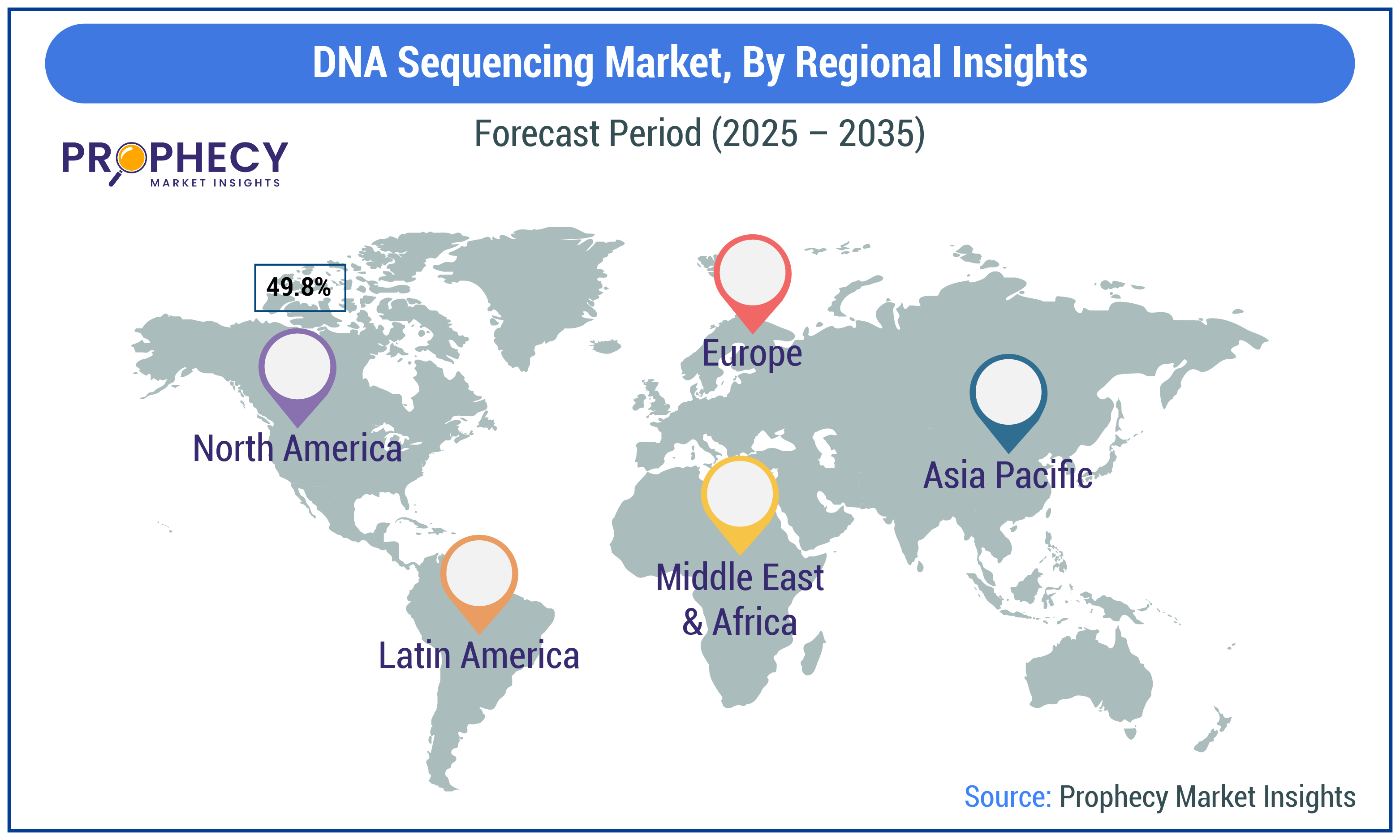
North America: North America has the largest DNA sequencing market share. This is due to its strong research infrastructure, government supports, sophisticated healthcare infrastructure, investments in biotechnology, government initiatives to promote medications, adoption of precision medicine, and technical breakthroughs.
- For instance, in March 2024, Nucleus Genomics, the next-generation genetic testing and Analysis Company, announced the launch of its DNA analysis product to bring the benefits of personalized medicine to everyone. This product also helped in bringing whole-genome sequencing the public.
Europe: Europe is the fastest growing region in DNA sequencing market. This is due to the region’s increasing demand for personalized medicine, new product launches, government supported genomics research, and a strong academic foundation.
- For instance, in May 2021, Novogene Europe, a leading provider of genomic services and solutions, announced the launch of a Clinical Service to offer its European customers with next-generation sequencing (NGS) services and solutions for its clinical samples. NGS is a widely used type of DNA sequencing.
DNA Sequencing Market Report Scope:
|
Attribute |
Details |
|
Market Size 2025 |
USD 14.9 Billion |
|
Projected Market Size 2035 |
USD 54.2 Billion |
|
CAGR Growth Rate |
15.2% (2025-2035) |
|
Base year for estimation |
2024 |
|
Forecast period |
2025 – 2035 |
|
Market representation |
Revenue in USD Billion & CAGR from 2024 to 2034 |
|
Regional scope |
North America - U.S. and Canada Europe – Germany, U.K., France, Russia, Italy, Spain, Netherlands, and Rest of Europe Asia Pacific – China, India, Japan, Australia, Indonesia Malaysia, South Korea, and Rest of Asia-Pacific Latin America - Brazil, Mexico, Argentina, and Rest of Latin America Middle East & Africa – GCC, Israel, South Africa, and Rest of Middle East & Africa |
|
Report coverage |
Revenue forecast, company share, competitive landscape, growth factors, and trends |
Segmentation:
By Product Type:
- Instruments
- Consumables
- Kits
- Reagents
- Others
By Technology:
- Sanger Sequencing
- Next-Generation Sequencing
- Third Generation Sequencing
- Others
By Workflow:
- Pre-Sequencing
- Sequencing
- Data Analysis
By Application:
- Oncology
- Precision Medicine
- Reproductive Health
- Forensics
- Clinical Investigations
- Biomarkers
- Diagnostics
- Others
By End User:
- Hospitals and Healthcare Organizations
- Academics and Research Institutions
- Pharmaceutical and Biotechnology Companies
- Others
By Region:
- North America
- U.S.
- Canada
- Europe
- Germany
- U.K.
- France
- Russia
- Italy
- Spain
- Netherlands
- Rest of Europe
- Asia Pacific
- China
- India
- Japan
- Australia
- Indonesia
- Malaysia
- South Korea
- Rest of Asia Pacific
- Latin America
- Brazil
- Mexico
- Argentina
- Rest of Latin America
- Middle East & Africa
- GCC
- Israel
- South Africa
- Rest of Middle East & Africa
Global DNA Sequencing Market By Competitive Landscape & Key Players
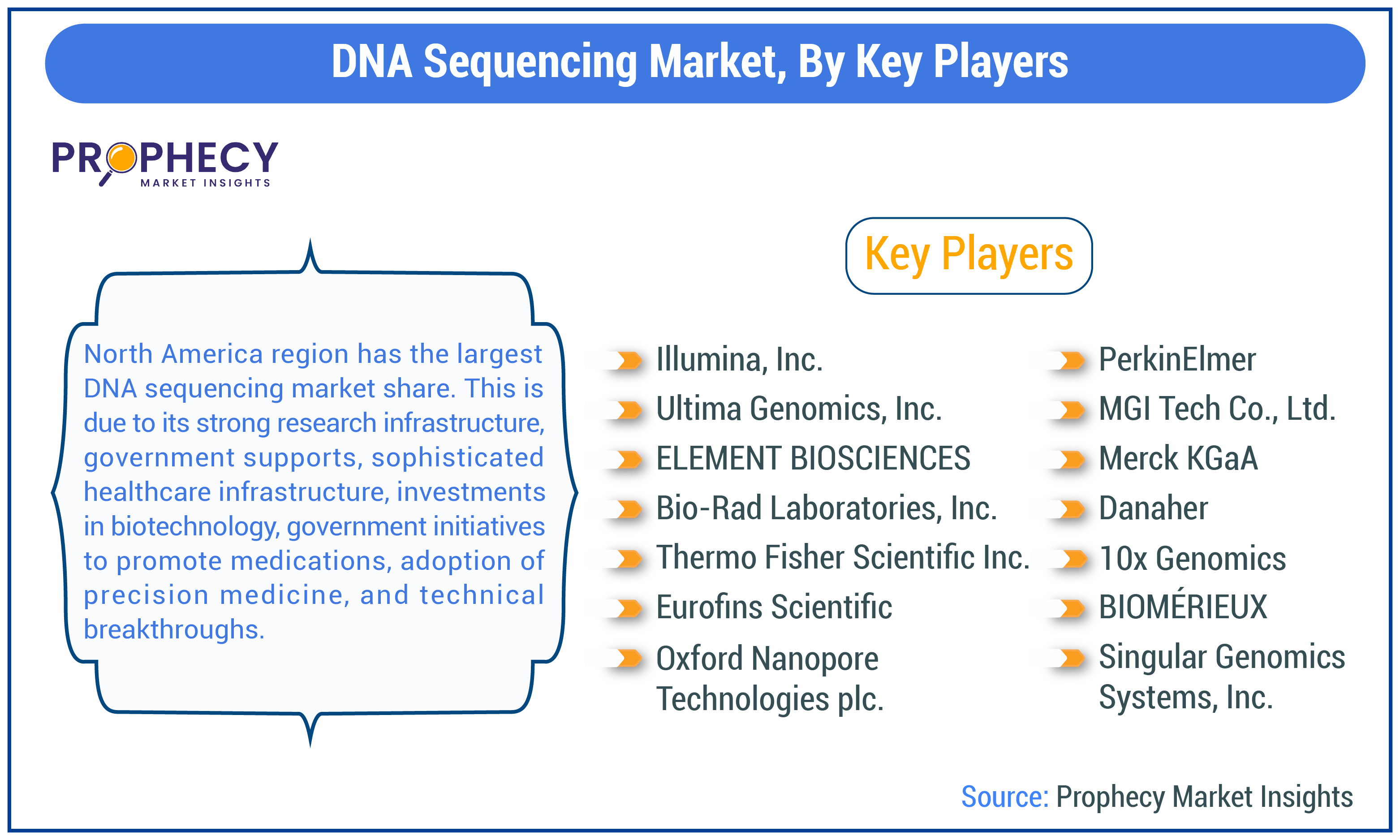
The companies operating in the market are Illumina, Inc., Ultima Genomics, Inc., OXFORD Nanopore Technologies plc., Singular Genomics Systems, Inc., 10x Genomics. These key players are applying plan of action including new product launch, whole genome sequencing, next-generation sequencing, and optical mapping, to drive market growth.
List of Key Players in the Market:
- Illumina, Inc.
- Ultima Genomics, Inc.
- Oxford Nanopore Technologies plc.
- Singular Genomics Systems, Inc.
- 10x Genomics
- MGI Tech Co., Ltd.
- Thermo Fisher Scientific Inc.
- Eurofins Scientific
- PerkinElmer
- Bio-Rad Laboratories, Inc.
- Merck KGaA
- Danaher
- ELEMENT BIOSCIENCES
- BIOMÉRIEUX
Global DNA Sequencing Market By Recent News
- In June 2023, Researchers from the Perelman School of Medicine at the University of Pennsylvania invented a new way to map specific DNA markings called 5-methylcytosine (5mC) which regulated gene expression and had key roles in health and disease. It was called the Direct Methylation Sequencing (DM-Seq) and was a type of DNA sequencing. The innovative technique allowed scientists to profile DNA using very small samples and without damaging the sample which meant it can potentially be used in liquid biopsies and early cancer detection.
- In February 2023, the Tamil Nadu Forest Department launched a DNA sequencing facility, which was, Sanger sequencing under the Centre for Wildlife Forensics and a wildlife histopathology laboratory under the Centre for Animal Care Sciences. These facilities were inaugurated to mark the two-day Annual Research Conference (ARC) 2023 on wildlife studies being held at the Advanced Institute for Wildlife Conservation (AUWC), Vandalur.
Analyst View:
DNA sequencing offers numerous benefits, including genetic variation identification, crime detection, pollutant detection, endangered species study, agricultural improvement, taxonomic analysis, high throughput sequencing, high resolution, and quantitative measurements, these factors are responsible for driving market growth.
More Related Reports
T4 DNA Ligase Market
DNA Synthesis Market
Next-Generation Anode Materials Market
Next-generation Products in Tobacco Market
Next-Generation Biofuels Market
Global DNA Sequencing Market By Company Profile
|
Company Name |
Illumina, Inc. |
|
Headquarter |
California, U.S. |
|
CEO |
Mr. Jacob Thaysen |
|
Employee Count (2024) |
9250 Employees |
Global DNA Sequencing Market By Highlights
FAQs
DNA sequencing market size was valued at USD 14.9 Billion in 2025 and is expected to reach USD 54.2 Billion by 2035 growing at a CAGR of 15.2%.
The market is segmented into product type, technology, workflow, application, end user, and region.
The market is segmented by region North America, Asia Pacific, Europe, Latin America, and the Middle East & Africa. North America is expected to dominate the Market.
The key players operating in the DNA sequencing market include Illumina, Inc., Ultima Genomics, Inc., Oxford Nanopore Technologies plc., Singular Genomics Systems, Inc., 10x Genomics, MGI Tech Co., Ltd., Thermo Fisher Scientific Inc., Eurofins Scientific, PerkinElmer, Bio-Rad Laboratories, Inc., Merck KGaA, Danaher, ELEMENT BIOSCIENCES, and BIOMÉRIEUX.