Global Health Insurance Third Party Overview
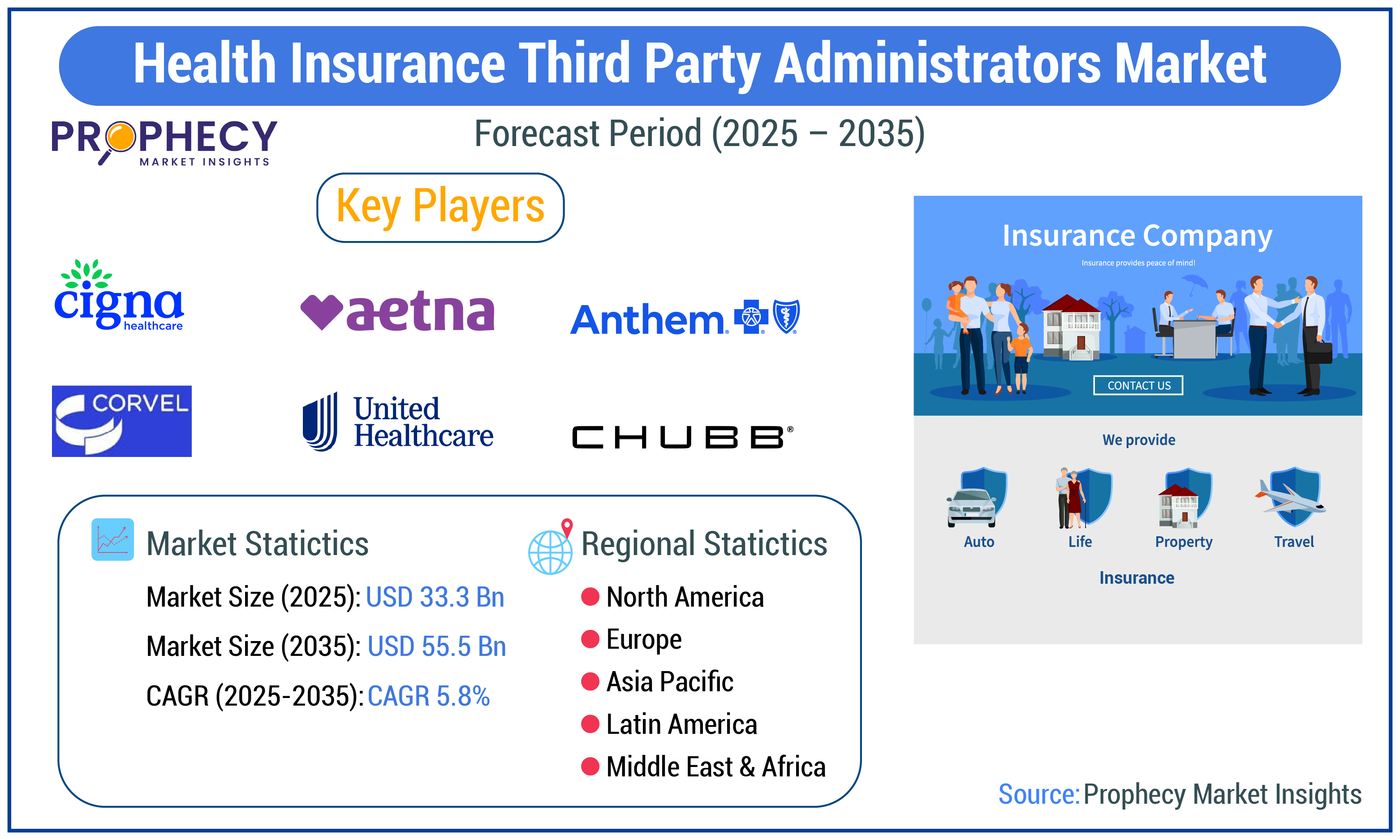
- By 2035, the health insurance third party administrators market size is contemplated to enlarge at a valuation of USD 55.5 Billion.
- In 2024, the health insurance third party administrators market valuation was USD 31.2 Billion.
- Health insurance third party administrators market is developing at a CAGR of 5.8%.
Health insurance third party administrators (TPAs) are people that act as a bridge who manage claims, hospital coordination, and customer support for insurers. They make some smart decisions that help in faster claim processing, smooth treatment without cash, and at the same time, the service of policyholders is improved via cutting the insurer's administrative workload.
Rising health care costs, increased health insurance coverage, and the necessity for efficient claims processing and customer service lead to the growth of Health Insurance Third Party Administrators (TPA) market. The insurers tend to delegate more administrative tasks to the TPAs in order to lighten their workload and, at the same time, provide faster processing and improved service quality. The expansion of digital health infrastructure, telemedicine, and the accompanying increase in regulatory support in various countries act as the yeast for the growth of tech-enabled TPAs that can supply health insurers with faster, transparent, and more efficient services.
Artificial intelligence, automation, and data analytics are the engines of digital transformation that will determine the health insurance TPA market's future. With claims processing, fraud detection, and customer service being handled by self-learning machines, people in charge can now focus themselves on developing the Quality and Performance of healthcare. TPAs are integrating with the management of the cost-efficient self-funded health plans, especially popular among medium-sized employers. In addition to these, the developing countries are spreading technology solutions which are fostering the growth of the market in emerging markets.
Recession Risk & Tariff Analysis:
- The health insurance third party administrators market can occurrence of a recession, and the costs associated with tariffs will be increased. As the economic situation gets worse, business owners might curtail insurance benefits which might in turn lead to a decrease in the number of claims and a drop in the revenues of TPAs.
- On the other hand, when we have to deal with medical goods that are tariffed, the situation becomes complicated and expensive for the claims to manage.
Impact of Generative AI on Health Insurance Third Party Administrators Market:
- The health insurance third party administrators market is being revolutionized by generative Al to execute not only claims processing but also fraud detection, and overhead works the outcome of which is quicker and more precise service delivery at lower costs.
- TPAs have adopted Al tools to assist them in real-time, gather insights with predictive analytics, and at the same time manage policies, resulting in customer satisfaction and operational efficiency. Through this, TPAs are also empowered with the technological capabilities to handle potentially tiring claim denials and appeals.
- It also makes them more strategic and data-driven partners for insurers, which eventually leads to an increase in market share and a more competitive position of the TPAs in the long run.
Global Health Insurance Third Party Drivers & Restraints
Key Drivers:
The Increasing Burden of Chronic Diseases can Boost the Market Growth
Symptoms of chronic diseases like diabetes, heart illnesses, and respiratory diseases are on the rise, which is boosting the usage of healthcare facilities and thus an increase in claims to insurance companies. This spike in the number of claims leads to an increasing need for safe and error-free claims management driving insurance companies to externalize the administration work to Third Party Administrators (TPAs). TPAs play a vital role in managing the high healthcare burden of chronic diseases mainly by improving claim processing, lessening the waiting time and ensuring that the claims.
- For Instance, according to the data published by VOX, each year 18 million people die from cardiovascular diseases that affect the heart and blood vessels and can lead to heart attacks, stroke, or heart failure. About 9 million people die each year from cancers, 4 million from chronic respiratory diseases such as asthma or COPD, and 2 million from diabetes.
Restraints:
The Potential of the Market can be Hampered by Growing Pressure to Adopt Costly Digital Technologies
Health insurance third party administrators are under increasing pressure to merge costly digital technologies such as Al, automation, cloud platforms, and data analytics to survive in the market, improve effectiveness, and satisfy the increasing needs of their customers. Nevertheless, these very tools entail a large sum of money as an initial investment, demand a professional workforce, and need continuous updating, which upon implementation can put the financial resources of the small to mid-sized TPAS under severe pressure.
- Counterbalance Statements: The easiest way to solve this problem is to use cloud-based, scalable platforms and team up with HealthTech companies that provide plug-and-play solutions or subscription-based models. This will enable TPAs to digitalize their processes slowly over time, regulate expenses, and be responsive in the fast-changing digital healthcare sector.
Opportunities & Trends:
Growth in Self-Funded Employer Health Plans will be a Game-Changer Solution for the Market in Future
The main factor that determines expansion in the Health Insurance TPA market is the increasing popularity of self-funded employer health plans. Companies that are in search of more control over healthcare spending and benefits customization, particularly medium-sized ones, deal with claims directly and give the administration of the activities to TPAs to a greater extent.
During the process of high yielding claims, the pen carrier or the TPA is required to handle claims, compliance, and the provision of plan details that MCOS who are payers of the opposite side are responsible for under the ERISA law. This leads to lowering of premiums for the health cost management process in all its aspects and giving information that the employers can use to a great extent, makes TPAs a must-have for any company who wants to maintain their [market] growth and secure the self-funded plan initiative.
Global Health Insurance Third Party Segmentations & Regional Insights
Service type, delivery model, insurance type, organization size, end user, and region are the divisions of the health insurance third party administrators market.
By Service Type:
Claims management, network management, enrollment services, care management, fraud detection, and others are service type on which health insurance third party administrators market is segmented. Since ensuring accurate, timely, and cost-effective processing of large volumes of insurance claims is the primary reason TPAs are hired, claims management has the largest health insurance third party administrator (TPA) market share.
The demand for wellness initiatives, preventative care coordination, and the treatment of chronic diseases is driving the second-dominant area, care management.
By Delivery Model:
Based on the delivery model, the health insurance third party administrators market is divided into outsourced TPAs, and in-house TPAs. In the health insurance third party administrators market, outsourced TPAs have the biggest health insurance third party administrator (TPA) market share due to insurers and self-funded employers prefer to work with specialized outside companies to lower administrative burden, save operating expenses, and obtain access to cutting-edge technologies and domain knowledge.
Large insurance companies and healthcare providers who desire more control over data, customer service, and procedures are the primary adopters of the second-dominant model, in-house TPAs. However, their adoption is restricted to larger organizations due to their high infrastructure and personnel costs.
By Insurance Type:
Individual health insurance, group/employer-sponsored health insurance, government health insurance, and others are insurance type of the health insurance third party administrators market. The highest health insurance third-party administrator (TPA) market share is held by group/employer-sponsored health insurance since many companies, particularly in developed and U.S. markets, depend on TPAs to effectively handle employee benefits.
The second-largest market is government health insurance, which is driven by national insurance programs and public health initiatives in nations consisting of the United States (Medicare/Medicaid) and India (Ayushman Bharat). These initiatives increasingly hire TPAs to expedite service delivery and guarantee compliance across large populations.
By Organization Size:
On the organization size, health insurance third party administrators market is categorized into small and medium enterprises (SMEs), and large enterprises. Due to their need for effective, extensive claims processing, compliance assistance, and data management, as well as the fact that they usually provide full employee health benefits, big enterprises have the highest market share in the health insurance third party administrator (TPA) market.
The second-dominant segment is small and medium businesses (SMEs), which are adopting TPAs at an increasing rate as they move toward self-funded health plans to control costs and provide competitive benefits to their employees. However, their share is lower on account of their smaller workforces and limited resources.
By End User:
The health insurance third party administrators market on the account of end user are categorized into insurance companies, government agencies, self-insured employers, brokers and agents, and others. The largest health insurance third-party administrator (TPA) market share is held by insurance companies, who mainly depend on TPAs to handle essential tasks consisting of policy administration, claims processing, and customer service effectively so they can concentrate on risk management and underwriting.
The second largest group is self-insured employers, which are increasingly using TPAs to administer benefits, claims, and care management as they transition to self-funded health plans in an effort to reduce costs and increase plan flexibility, particularly for mid-to-large businesses.
Regional Insights:
Geographically, the health insurance third party administrators market is studied across North America, Europe, Asia Pacific, Latin America, and the Middle East & Africa.
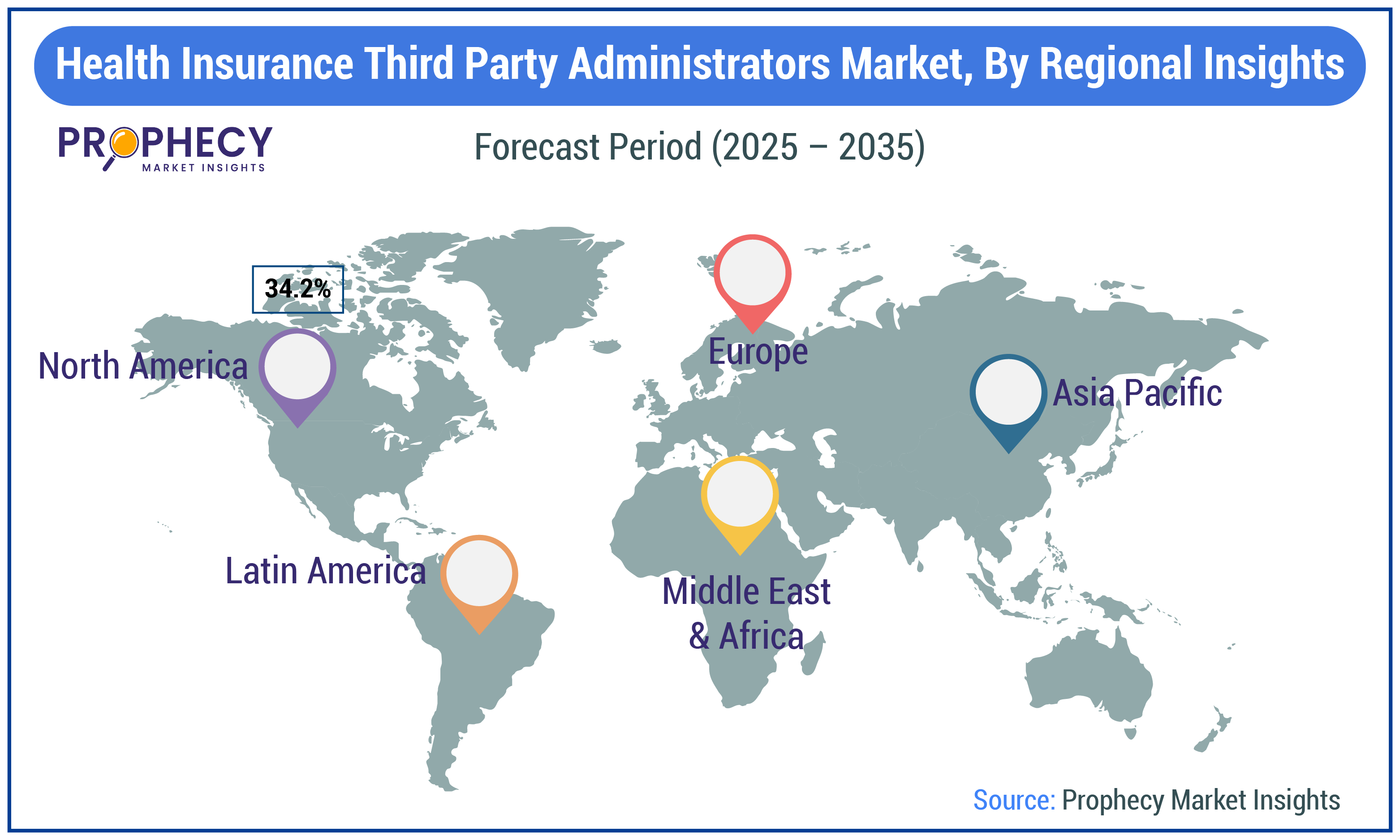
North America: The health insurance third party administrators (TPA) market is dominated by North America due to the region's developed healthcare system, high private health insurance penetration, and broad use of self-funded employer plans. Thanks to advantageous laws and cutting-edge technological capabilities, the U.S. leads the area in the number of TPAs handling claims for major insurers and self-insured firms.
- U.S. Health Insurance Third Party Administrators Market Insights:
Due to the country's extensive usage of self-funded employer health plans, highly privatized healthcare system, and several health insurers outsourcing administrative tasks, the United States leads the North American market for health insurance third party administrators (TPAs). The United States is the center of TPA activities due to its leadership in digital adoption and regulatory frameworks.
Europe: Due to its expanding private health insurance market, rising rates of chronic illness, and need for effective healthcare management particularly in nations including Germany and the UK where the adoption of digital health is accelerating Europe is the second-dominant area.
- Germany Health Insurance Third Party Administrators Market Insights:
Germany's strong public-private healthcare architecture, high insurance coverage rate, and rising need for effective claims and benefits management have made it the leader in Europe. The expansion of the TPA market is further supported by Germany's emphasis on regulatory openness and the transition of digital health.
Asia Pacific: This region health insurance third party administrators (TPAs) market is expanding quickly as a result of growing middle-class populations looking for greater health coverage, rising healthcare expenditures, and increased insurance penetration. The need for effective claims and policy administration is also being fueled by government initiatives supporting both public and commercial health insurance programs as well as the digital revolution of healthcare services.
- India Health Insurance Third Party Administrators Market Insights:
With a sizable insured population, the growth of government initiatives such as Ayushman Bharat, and regulatory frameworks requiring the use of licensed TPAs, India leads the APAC TPA market. India's dominance in the area is further strengthened by its robust digital infrastructure and expanding private health insurance market.
Health Insurance Third Party Administrators Market Report Scope:
|
Attribute |
Details |
|
Market Size 2025 |
USD 33.3 Billion |
|
Projected Market Size 2035 |
USD 55.5 Billion |
|
CAGR Growth Rate |
5.8% (2025-2035) |
|
Base year for estimation |
2024 |
|
Forecast period |
2025 – 2035 |
|
Market representation |
Revenue in USD Billion & CAGR from 2025 to 2035 |
|
Regional scope |
North America - U.S. and Canada Europe – Germany, U.K., France, Russia, Italy, Spain, Netherlands, and Rest of Europe Asia Pacific – China, India, Japan, Australia, Indonesia, Malaysia, South Korea, and Rest of Asia-Pacific Latin America - Brazil, Mexico, Argentina, and Rest of Latin America Middle East & Africa – GCC, Israel, South Africa, and Rest of Middle East & Africa |
|
Report coverage |
Revenue forecast, company share, competitive landscape, growth factors, and trends |
Segmentation:
By Service Type:
- Claims Management
- Network Management
- Enrollment Services
- Care Management
- Fraud Detection
- Others
By Delivery Model:
- Outsourced TPAs
- In-house TPAs
By Insurance Type:
- Individual Health Insurance
- Group/Employer-Sponsored Health Insurance
- Government Health Insurance
- Others
By Organization Size:
- Small and Medium Enterprises (SMEs)
- Large Enterprises
By End User:
- Insurance Companies
- Government Agencies
- Self-Insured Employers
- Brokers and Agents
- Others
By Region:
- North America
- U.S.
- Canada
- Europe
- Germany
- U.K.
- France
- Russia
- Italy
- Spain
- Netherlands
- Rest of Europe
- Asia Pacific
- China
- India
- Japan
- Australia
- Indonesia
- Malaysia
- South Korea
- Rest of Asia Pacific
- Latin America
- Brazil
- Mexico
- Argentina
- Rest of Latin America
- Middle East & Africa
- GCC
- Israel
- South Africa
- Rest of Middle East & Africa
Global Health Insurance Third Party Competitive Landscape & Key Players
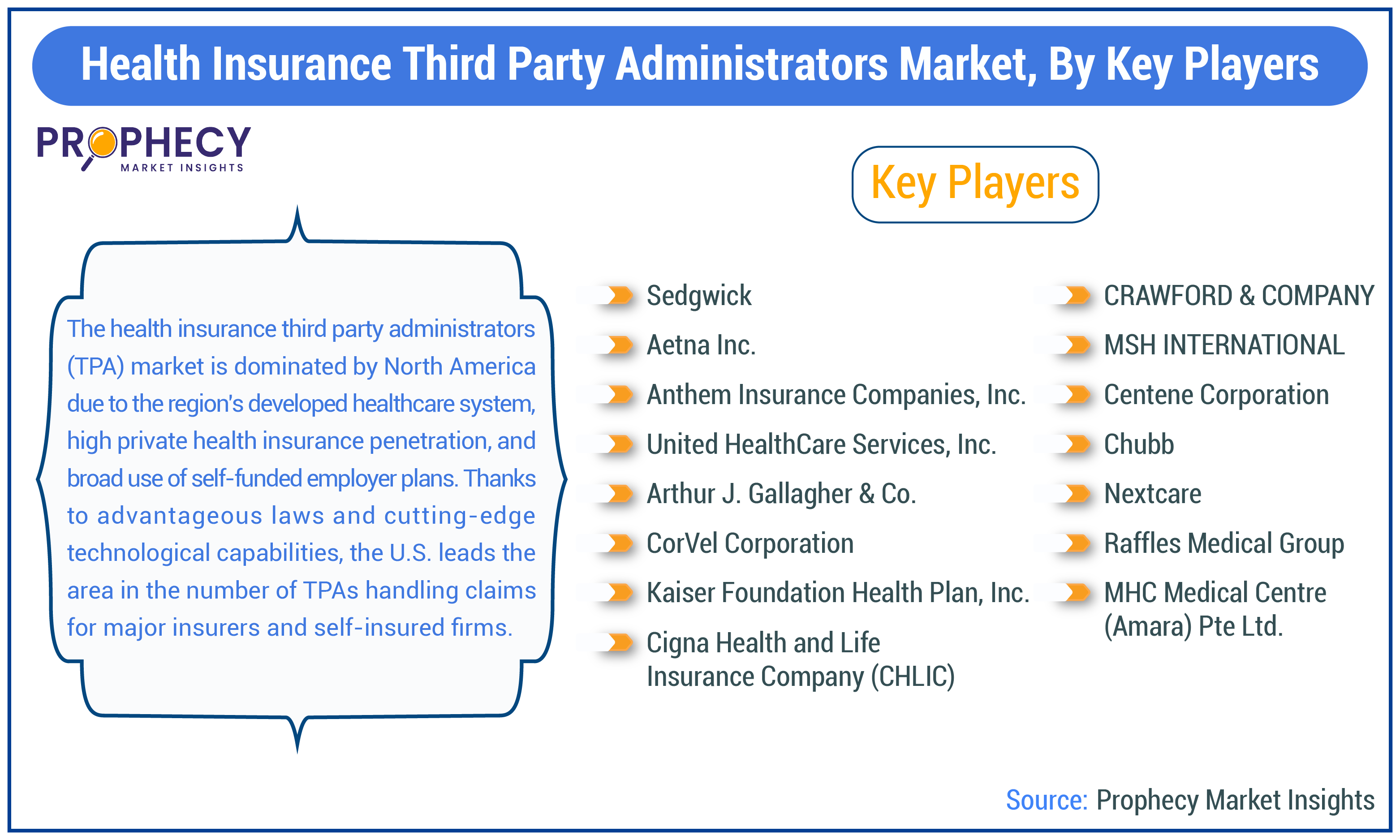
The key players operating in the health insurance third party administrators market include, Sedgwick, Cigna Health and Life Insurance Company (CHLIC), CRAWFORD & COMPANY, United HealthCare Services, Inc., Arthur J. Gallagher & Co., and others. In order to increase efficiency and competitiveness, health insurance TPA firms develop by using digital tools, entering growing markets, establishing strategic alliances, and providing services including fraud detection and care management.
Health Insurance Third Party Administrators Market Companies:
- Sedgwick
- Cigna Health and Life Insurance Company (CHLIC)
- Aetna Inc.
- Anthem Insurance Companies, Inc.
- United HealthCare Services, Inc.
- Arthur J. Gallagher & Co.
- CorVel Corporation
- Chubb
- CRAWFORD & COMPANY
- MSH INTERNATIONAL
- Centene Corporation
- Kaiser Foundation Health Plan, Inc.
- Nextcare
- Raffles Medical Group
- MHC Medical Centre (Amara) Pte Ltd.
View an Additional List of Companies in the Health Insurance Third Party Administrators Market
Global Health Insurance Third Party Recent News
- In August 2024, the '15-Minute Express Discharge' service for employee health insurance cashless claims has been introduced by Policybazaar for Business, a branch of Policybazaar Insurance Brokers Private Ltd, in collaboration with Paramount Health TPA and insurance carriers. The goal of this service is to significantly cut down on the length of time patients must wait after being released from hospitals.
Analyst View:
Health insurance third party administrators (TPAs) are essential middlemen that lessen the administrative burden on insurers by streamlining claims, hospital coordination, and customer support. The demand for effective service delivery, growing insurance coverage, and growing healthcare expenditures are the main factors propelling market expansion. This rise is further fueled by the incorporation of telemedicine, digital health tools, and supporting policies. In the future, TPAs will become tech-enabled service providers thanks to advancements in AI, automation, and data analytics. This will be especially advantageous for self-funded employer plans and will spur growth in emerging markets.
More Related Reports
Smart Healthcare Products Market
Healthcare Biometric Market
Artificial Intelligence in Healthcare Market
Digital Health Market
Healthcare Finance Solutions Market
Global Health Insurance Third Party Company Profile
|
Company Name |
Sedgwick |
|
Headquarter |
Memphis, U.S. |
|
CEO |
Stephen Kerr |
|
Employee Count |
33,000 Employees |
Global Health Insurance Third Party Highlights
FAQs
Health insurance third party administrators market size was valued at USD 33.3 Billion in 2025 and is expected to reach USD 55.5 Billion by 2035 growing at a CAGR of 5.8%.
Service type, delivery model, insurance type, organization size, end user, and region are the segmentation for the health insurance third party administrators market market.
North America, Asia Pacific, Europe, Latin America, and the Middle East & Africa. North America is expected to dominate the market.
The key players operating the health insurance third party administrators market include Sedgwick, Cigna Health and Life Insurance Company (CHLIC), Aetna Inc., Anthem Insurance Companies, Inc., United HealthCare Services, Inc., Arthur J. Gallagher & Co., CorVel Corporation, CHUBB, CRAWFORD & COMPANY, MSH INTERNATIONAL, Centene Corporation, Kaiser Foundation Health Plan, Inc., Nextcare, Raffles Medical Group, and MHC Medical Centre (Amara) Pte Ltd..