Global SelfDrive Car Rental Market Overview
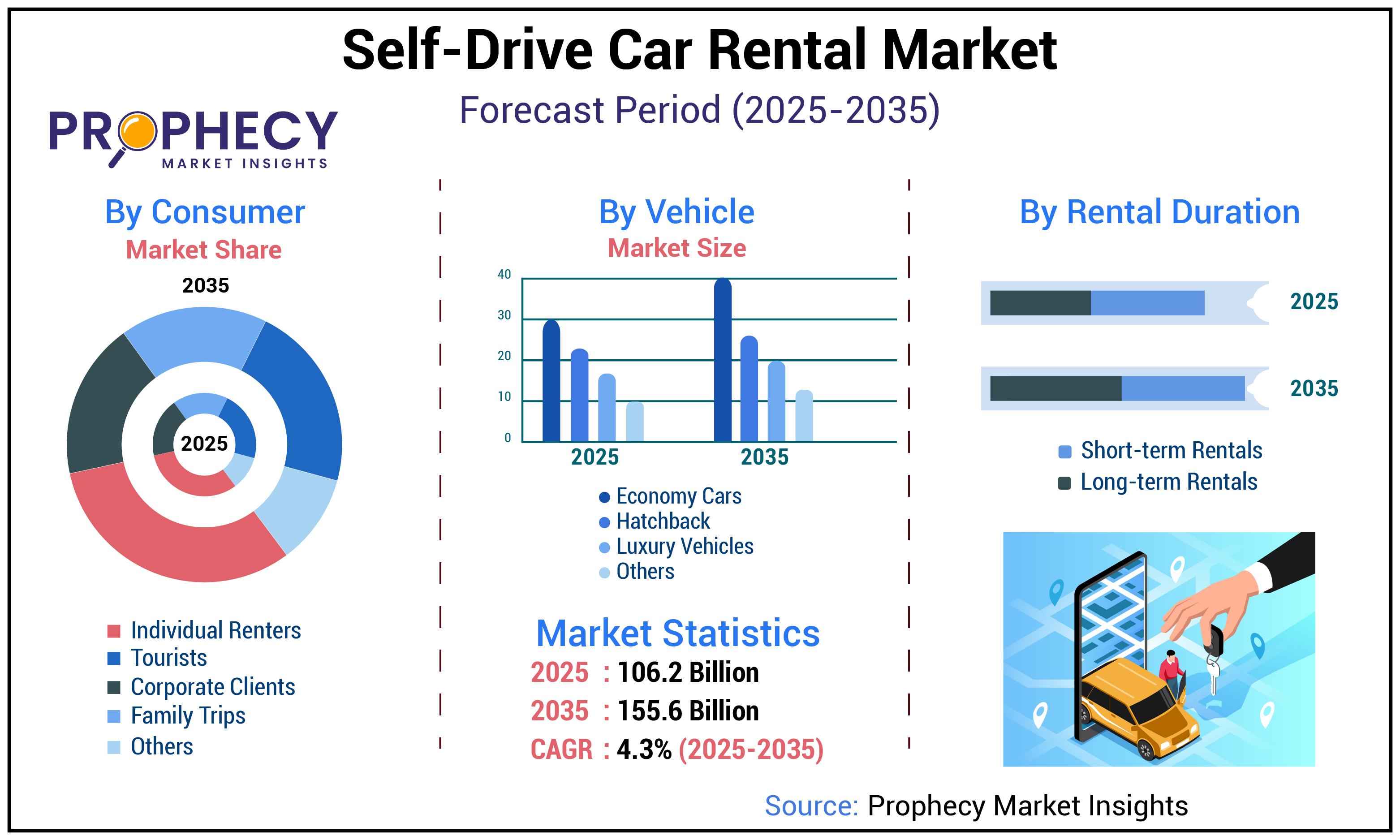
- Self-drive car rental market size is expected to increase at a rate of USD 155.6 Billion, by 2035.
- In 2024, the Self-drive car rental market valuation was USD 102.6 Billion.
- Self-drive car rental market is growing at a CAGR 4.3%.
Self-drive car rental is a service where customers can rent a vehicle and drive it themselves without the need for a chauffeur or driver. In this model, individuals or businesses can rent cars for a specific period, ranging from a few hours to several days or weeks, and are responsible for driving the car to their desired destination.
Self-drive rental services are available through many car rental companies, both locally & globally. Rental cars come with terms & conditions, such as age restrictions, insurance requirements, and limits on mileage, payment is usually based on the rental period, with additional charges for fuel, insurance, and any damage to the vehicle. These services offer more convenience and choice for customers looking for short-term vehicle rentals.
Increasing urbanization, availability of public transport, and more cost-effective than owing a vehicle for individuals, is anticipated to drive self-drive car rental market growth. The growing demand for more flexible transportations, especially for short trips, vacations, rise in mobile apps, online platforms, and increasing availability of electric vehicles, is expected to propel self-drive car rental market growth.
Growth in Peer-to-Peer car sharing, adoption of autonomous vehicles, and integration with ride-sharing platforms, is expected to create opportunities for self-drive car rental market growth. The increasing popularity of urban mobility, emerging technologies, such as AI, machine learning, IoT to enhance customer experience, and partnership with hotels, airlines, are projected to boost self-drive car rental market growth.
Impact of Generative AI on Self-Drive Car Rental Market:
- AI can analyze historical data and predict customer demand, which allows self-drive rental companies to implement dynamic pricing strategies. AI can offer personalized vehicle suggestions, by analyzing customer’s previous rental history, location, and preference. AI-driven algorithms can analyze vehicle data and predict the maintenance period of car.
- AI can optimize fleet utilization by analyzing customer demand patterns, weather conditions, traffic conditions, and booking trends. AI-powered navigation systems can integrate with self-drive vehicles, offering guidance on fuel-efficient routes, avoiding traffic congestion, and minimizing wear and tear on the vehicle.
Global SelfDrive Car Rental Market Drivers & Restraints
Key Drivers:
Rising Urbanization is Predicated for Market Growth
As more people migrate to urban centers in search of better economic opportunities, education, healthcare, and infrastructure, cities are experiencing significant changes in mobility needs, transportation behavior, and lifestyle preferences. This rapid urban shift is creating a favorable environment for flexible and technology-driven mobility solutions such as self-drive car rentals. The growing number of urban people are moving toward to access-based transportation models, to prefer rent or share vehicles based on their need, rather than adopting the full-time cost and responsibility of ownership.
This behavioral shift directly fuels the demand for self-drive rental services, which offer flexibility, convenience, and freedom. Urban areas typically have better digital infrastructure and internet connectivity, which supports the growth of app-based rental platforms. The rising urban tourism, and business travel, increases the demand for rental volumes, especially near airports, hotels, and commercial districts, is expected to pitch self-drive car rental market growth.
- For instance, according to data published by Our World in Data, in December 2024, more than 4 billion people now live in urban areas. This shift is set to continue, with the urban population expected to more than double by 2050, at which point nearly 7 in 10 people will live in cities. In most high-income countries, across Western Europe, the Americas, Australia, Japan, and the Middle East, more than 80% of the population lives in urban areas. Across most upper-middle-income countries, in Eastern Europe, East Asia, North and Southern Africa, and South America, 50% to 80% of people live in urban areas.
Restraints:
High Initial and Maintenance Costs of Vehicles can Hinder Market Growth
Maintaining a diverse and modern rental fleet, especially with premium, electric, or autonomous vehicles, requires significant capital investment. Regular servicing, insurance, cleaning, and repairs increases the operational costs. High insurance premiums and rapid vehicle depreciation reduce profit margins, resulting to hinder market growth.
- Counterbalance Statements: To mitigate these costs, companies can adopt fleet-sharing models, such as peer-to-peer rentals, partner with automotive manufacturers for bulk purchasing discounts, and invest in predictive maintenance powered by AI to reduce long-term repair costs. The use of electric vehicles, can lower long-term fuel and maintenance expenses.
Opportunities & Trends:
Growing Tourism can Surge Market Growth
Modern travelers, especially millennials and Gen Z, increasingly value freedom and autonomy in their travel experiences. Instead of relying on guided tours, public transportation, or taxis, many individuals prefer self-drive rentals to explore destinations at their own places. This shift in tourist behavior is driving demand for rental services, particularly in scenic regions, national parks, coastal towns, and countryside destinations. In recent years, especially following the COVID-19 pandemic, there has been a strong rise in domestic tourism, in which travelers prefer to explore nearby cities or rural areas via road trips.
This trend has increased the need for short-term vehicle rentals, as travelers choose for road-based travel over air or train transport. Tourists traveling with families or groups often find self-drive car rentals to be more cost-effective and convenient than booking multiple taxis or relying on public transport. Tourism growth also opens the door for strategic partnerships with hotels, travel agencies, resorts, and online travel platforms (OTAs), resulting to create significant opportunities for self-drive rental car market share.
- For instance, according to article published by UN Tourism 2025, 1.4 billion international tourists were recorded around the world in 2024, an increase of 11% over 2023, or 140 million more in 2024. The growing tourism were driven by post-pandemic demand, robust performance from large source markets globally and ongoing destinations recover in the Asia and the Pacific.
- The Middle East remained strongest-performing region, with international arrivals climbing 32% above pre-pandemic levels in 2024. Total export revenues from tourism (including passenger transport) are estimated at a record USD 1.9 trillion in 2024, about 3% higher than before the pandemic and 4% more than in 2019. International tourist arrivals are expected to grow 3% to 5% in 2025 compared to 2024, according to preliminary estimates.
Global SelfDrive Car Rental Market Segmentations & Regional Insights
The self-drive car rental market is segmented into consumer type, vehicle types, rental duration, application, Booking Channel, and region.
By Consumer Type:
On the basis of consumer type, the self-drive car rental market is classified into, individual renters, corporate clients, tourists, family trips, and others. Individual renters represent the largest and most dominant segment in the self-drive car rental market. Urban lifestyles, shift away from car ownership in metro areas, use of rentals for personal weekends, high demand for tech-savvy consumers, that refer app-based, on-demand rental services, and flexibility of choosing different vehicle types, is anticipated to boost segment’s growth in self-drive car rental market share.
Tourists form the second-largest consumer type segment in market. Increased demand for freedom, flexibility during vacations, the popularity of road trips, self-guided tours, easy to renting vehicles at airports, train stations, hotel hubs, and growth post-pandemic domestic tourism, is expected to pitch growth of segment in self-drive car rental market size.
By Vehicle Type:
Economy cars, luxury vehicles, hatchback, and others are categorized based on vehicle type for market. Economy cars is the leading segment in market, due to their affordability, fuel efficiency, and practicality. Economy cars are particularly preferred for daily rentals, urban commuting, and road trips. Their low rental costs make them highly attractive to individual renters, tourists, and business travelers, contributing to their dominance in the market, resulting to boost self-drive car rental market share.
Hatchbacks is the fastest growing segment in market. Hatchbacks offer more affordable and fuel-efficient, which demands to a wide range of customers looking for versatile, cost-effective vehicles for short-term rentals, is projected to propel growth of segment in self-drive car rental market size.
By Rental Duration:
Short-term rentals and long-term rentals are classified by rental duration for self-drive car rental market. Short-term is the dominating segment in market. The rising demand for flexible, on-demand mobility solutions that meet the needs of both urban residents and travelers. The rise of app-based platforms, and alignment with the modern consumers’ preference, is estimated to growth of segment in self-drive car rental market share.
By Application:
Under application, the market is classified into leisure and vacation travel, intercity and intracity rentals, subscription and leasing services, airport rentals, and others. Intercity and intracity rentals are the dominating application segment in the market. These rentals offer flexibility in terms of duration, pickup/drop-off locations, and vehicle type, which is highly attractive for daily use or weekend getaways, the expansion of business travel, rises the demand for rental cares, is predicated to drive segment’s expansion in self-drive car rental market share.
By Booking Channel:
Based on booking channel, the market is classified into online platforms, rental company websites, direct booking at rental locations, travel agents, and corporate bookings. The market is dominated by online platforms, due to increasing use of smartphones, and mobile apps in tech-savvy consumers. Online platforms provide real-time vehicle availability, dynamic pricing, and location-based services, improving the booking experience and encouraging repeat usage, is anticipated to fuel segment’s growth in self-drive car rental market size.
Regional Insights:
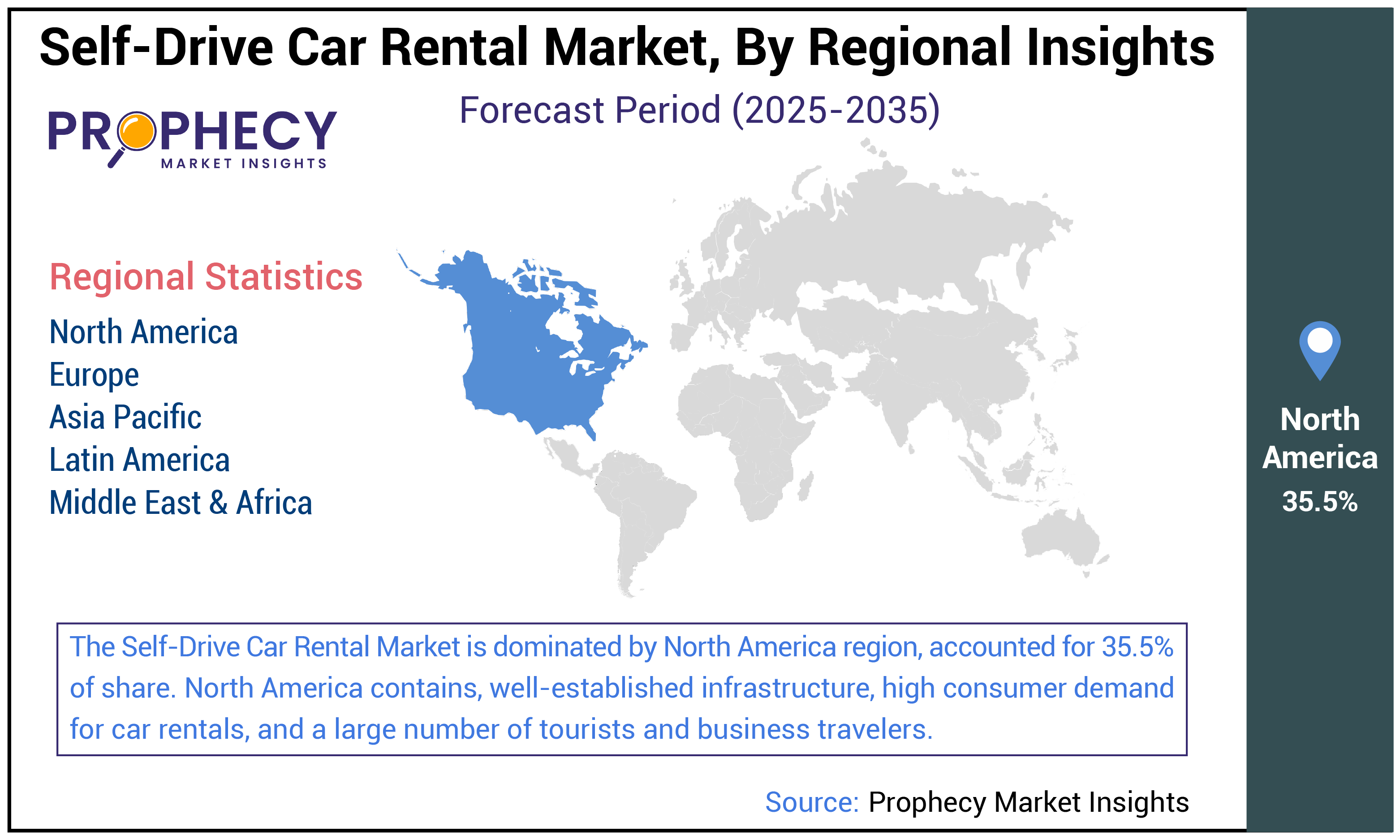
Geographically, the market is studied across North America, Europe, Asia Pacific, Latin America, and the Middle East & Africa.
North America: The self-drive car rental market is dominated by North America region, accounted for 35.5% of share. North America contains, well-established infrastructure, high consumer demand for car rentals, and a large number of tourists and business travelers. North America has a strong presence of global car rental companies, with the widespread adoption of online booking platforms, resulting to boost region development in self-drive car rental market size.
- U.S. Self-Drive Car Rental Market Insights:
U.S. is the dominating country in North America. The U.S. has a large and well-established market for self-drive car rentals, supported by a highly developed tourism industry, business travel, and a widespread culture of road trips. U.S. has extensive infrastructure and a high demand for mobility solutions, driving the growth of the self-drive car rental market.
Asia Pacific: This region is growing at highest share in market, due to rapid urbanization, and increasing tourism. The rise of digital platforms for booking self-drive cars, the tourism sector is growing in many parts of Asia-Pacific, creating a surge in demand for self-drive car rental, particularly among tourists visiting popular destinations. This region's rapid economic development, with a shift in consumer preferences towards mobility-as-a-service, is projected to fuel region growth in self-drive car rental market share.
- China Self-Drive Car Rental Market Insights:
China is leading country in Asia Pacific region for self-drive car rental market. China’s rapid urbanization, increasing middle class, and growing tourism sector have significantly fueled the demand for self-drive car rental. The rise of technology platforms, such as online booking apps, and expanding road infrastructure, is anticipated to propel self-drive car rental market share.
Europe: This region self-drive car rental market is experiencing steady growth, driven by several key factors, such as a well-established infrastructure, widespread digital adoption, and increasing urbanization, contributing to the demand for self-drive car rental. Most popular travel destination, significant urbanization, and technological advancement in car rental industry, is estimated to impel self-drive car rental market growth.
- U.K. Self-Drive Car Rental Market Insights:
U.K. is the dominating country in Europe. It contains high level of tourism, business travel, and a robust car rental market. It has a well-developed infrastructure, and companies. The strong demand for both short-term and long-term rentals, especially in urban areas and tourist hotspots, driving the dominance of the self-drive car rental market.
|
Attribute |
Details |
|
Market Size 2025 |
USD 106.2 Billion |
|
Projected Market Size 2035 |
USD 155.6 Billion |
|
CAGR Growth Rate |
4.3% (2025-2035) |
|
Base year for estimation |
2024 |
|
Forecast period |
2025 – 2035 |
|
Market representation |
Revenue in USD Billion & CAGR from 2025 to 2035 |
|
Regional scope |
North America - U.S. and Canada Europe – Germany, U.K., France, Russia, Italy, Spain, Netherlands, and Rest of Europe Asia Pacific – China, India, Japan, Australia, Indonesia, Malaysia, South Korea, and Rest of Asia-Pacific Latin America - Brazil, Mexico, Argentina, and Rest of Latin America Middle East & Africa – GCC, Israel, South Africa, and Rest of Middle East & Africa |
|
Report coverage |
Revenue forecast, company share, competitive landscape, growth factors, and trends |
Segmentation:
By Consumer Type:
- Individual Renters
- Corporate Clients
- Tourists
- Family Trips
- Others
By Vehicle Type:
- Economy Cars
- Luxury Vehicles
- Hatchback
- Others
By Rental Duration:
- Short-term Rentals
- Long-term Rentals
By Application:
- Leisure and Vacation Travel
- Intercity and Intracity Rentals
- Subscription and Leasing Services
- Airport Rentals
- Others
By Booking Channel:
- Online Platforms
- Rental Company Websites
- Direct Booking at Rental Locations
- Travel Agents
- Corporate Bookings
By Region:
- North America
- U.S.
- Canada
- Europe
- Germany
- U.K.
- France
- Russia
- Italy
- Spain
- Netherlands
- Rest of Europe
- Asia Pacific
- China
- India
- Japan
- Australia
- Indonesia
- Malaysia
- South Korea
- Rest of Asia Pacific
- Latin America
- Brazil
- Mexico
- Argentina
- Rest of Latin America
- Middle East & Africa
- GCC
- Israel
- South Africa
- Rest of Middle East & Africa
Global SelfDrive Car Rental Market Competitive Landscape & Key Players
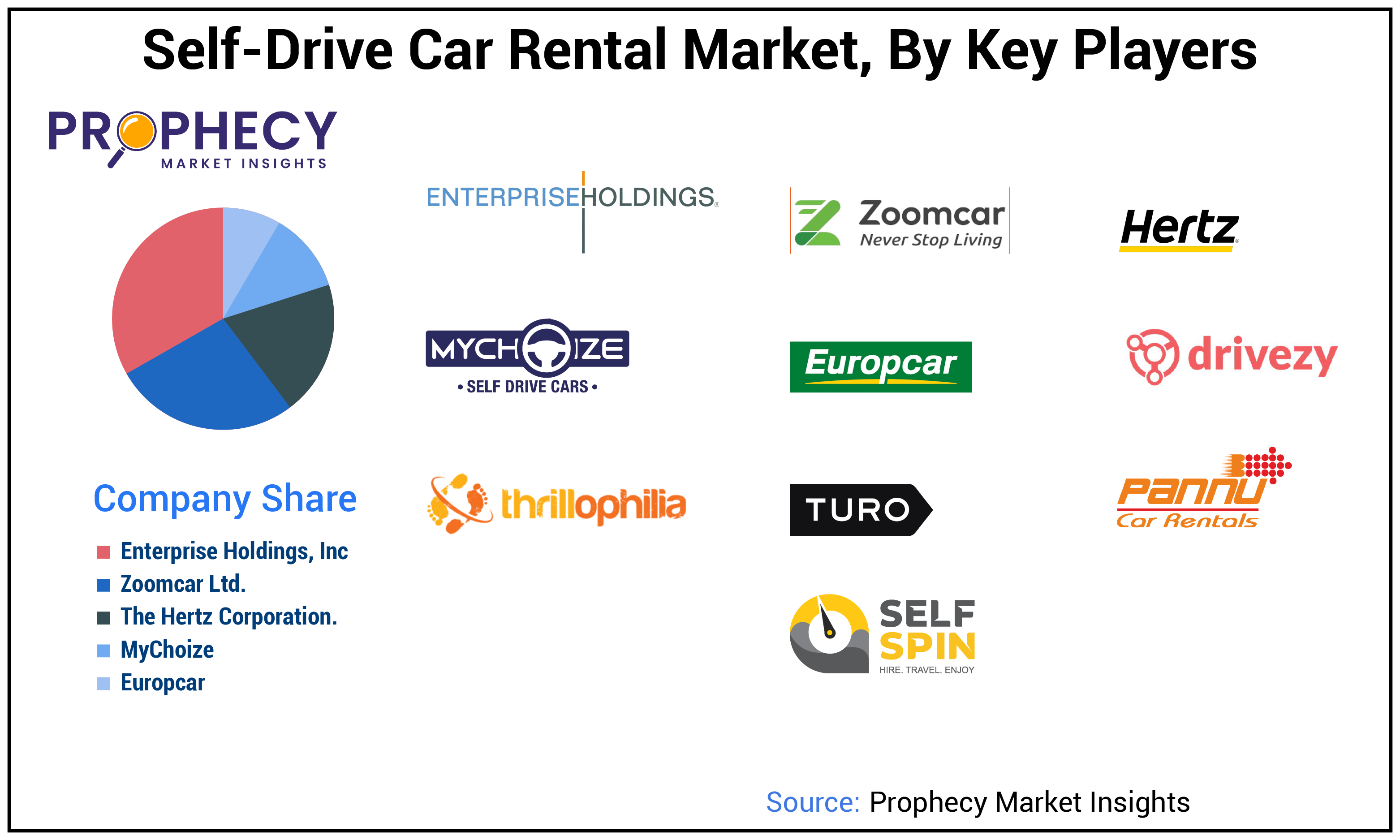
The major companies are active in the Enterprise Holdings, Inc., Zoomcar Ltd., The Hertz Corporation., and others. This companies are offering competitive rates, discounts, and promotional offers can attract customers. Companies are focusing on offer user-friendly mobile apps for booking, managing rentals, and customer through their acquisition. The major key players are collaborating with hotels, corporate companies, and others to expand their portfolio, is expected to growth of self-drive car rental market.
Self-Drive Car Rental Market Companies:
- Enterprise Holdings, Inc
- Zoomcar Ltd.
- The Hertz Corporation.
- MyChoize
- Europcar
- Drivezy, Inc.
- Thrillophilia.com
- Pannu Car Rental Pvt. Ltd.
- RBTS Car Rentals - Luxury & Self Drive Cars
- Selfspin
- Turo
- Getaround
- Sixt
- Primemover Mobility Technologies Pvt Ltd.
- KAYAK
View an Additional List of Companies in the Self-Drive Car Rental Market
Global SelfDrive Car Rental Market Recent News
- In January 2025, FlightHub announced partnership with Momentum Ventures, and Turo, particularly for North American travelers. This new offering aimed to provide North American travelers with a convenient platform to access reliable transportation options, whether planning a weekend getaway or a business trip, where it can enjoy the freedom to choose from a diverse range of vehicles that suit their individual preferences.
- In May 2024, SelfDrive Mobility, announced its expansion into the U.K., Scotland, and Ireland. The company aimed to offer vehicle rental and subscription services, with a fleet sourced directly from dealerships and car rental companies across more than 30 car brands and more than 100 locations. Customers now book cars on demand or subscribe to a brand-new car seamlessly. SelfDrive was the first mobility tech company that integrate AI into its app, to offer a convenient experience to customers.
Analyst View:
The self-drive car rental market is experiencing dynamic growth, driven by several key factors such as increasing urbanization, rising consumer demand for flexibility, and technological advancements. Expansion of electric vehicles, growing in tourism, and leisure travel, shift from long-term ownership to short-term rental models, is rises the demand for self-drive car rental, resulting to drive self-drive car rental market growth.
More Related Reports
Autonomous Cars Market
Self-Guided Vehicles Market
Autonomous Delivery Vehicle Market
Autonomous Vehicle Market
Fleet Management System Market
Global SelfDrive Car Rental Market Company Profile
|
Company Name |
Green Motion International |
|
Headquarter |
Milton Keynes, Buckinghamshire |
|
CEO |
Richard Lowden |
|
Employee Count |
171 Employees |
Global SelfDrive Car Rental Market Highlights
FAQs
Self-drive car rental market size was valued at USD 106.2 Billion in 2025 and is expected to reach USD 155.6 Billion by 2035 growing at a CAGR of 4.3%.
Consumer type, vehicle type, rental duration, application, Booking Channel, and region are the segmentation for the self-drive car rental market.
North America, Asia Pacific, Europe, Latin America, and the Middle East & Africa. North America is expected to dominate the market.
The key players operating in the self-drive car rental market include Enterprise Holdings, Inc., Zoomcar Ltd., The Hertz Corporation, MyChoize, Europcar, Drivezy, Inc., Thrillophilia.com, Pannu Car Rental Pvt. Ltd., RBTS Car Rentals - Luxury & Self Drive Cars, Selfspin, Turo, Getaround, Sixt, Primemover Mobility Technologies Pvt Ltd., and KAYAK